
#76- Small Habits, Big Results
-Why simplicity often works better than the “perfect” plan
Most people assume that meaningful progress in health and fitness requires doing more.
More structure.
More discipline.
More intensity.
But in practice, the opposite is often true.
The most consistent and lasting results tend to come from small, manageable habits — repeated over time.
This became very clear during a recent 6-week health project I worked on, where one participant’s approach stood out in a meaningful way.

A Different Starting Point
At the beginning of the health challenge, participants completed a baseline consultation and measurement, followed by a final check-in six weeks later.
One participant came in with a very clear intention.
She wanted change but was not willing to:
track macros.
increase her training volume.
start a new exercise regime
follow a strict or restrictive plan.
She had previous experience with rigid approaches that led to overwhelm and eating disorder and was looking for something simpler — something she could realistically maintain.
The Approach
Instead of building a complex plan, we focused on one area:
How to structure her meals in a simple and practical way.
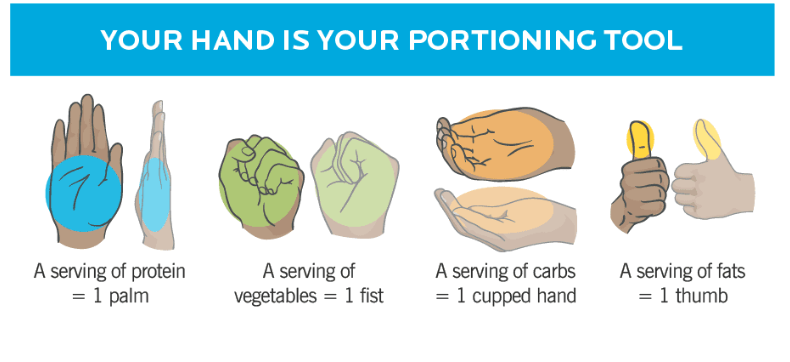
We introduced a basic portion guide using her hands:
Protein: palm size
Carbohydrates: cupped hand
Fats: thumb
Vegetables: fist
2. From there, we discussed what would be realistic for her day-to-day life.
Not perfection.
Not every meal.
Just consistency where it mattered most.
3. We also outlined simple examples of how this could look across:
breakfast
lunch
dinner
eating out or social situations
Importantly, nothing was removed.
There was still space for all foods — the focus was on improving everyday structure.
After six weeks
she returned for her follow-up and end of the health challange.
She doubted anything had happened, because she did not find it hard…..
and loosing weight should be hard right?
but she had lost 8 kilograms.
While that is a significant result, the more important takeaway is how it happened.

What Made the Difference
Most fat loss approaches tend to emphasize do’s and dont’s and being forceful:
increasing training volume
strict dietary rules
removing certain foods
tracking and optimizing intake
This approach did none of that.
Instead, it focused on:
simplifying decisions
reducing friction
creating a structure that worked on normal days
And it worked, even during a period that included:
family-related stress
disrupted routines
everyday life demands
She was able to maintain the habit.

Why This Approach Works
There are three key reasons this type of approach is effective.
1. It reduces decision fatigue
When you remove the need to constantly evaluate:
what to eat
how much to eat
whether it is “right”
you free up mental energy.
A simple structure removes unnecessary friction.
2. It builds awareness without overwhelm
This approach keeps you engaged with your choices, without requiring detailed tracking or precision.
You remain aware of your intake, but without the pressure of perfection.
3. It is repeatable
This is the most important factor.
Progress does not come from what you do occasionally.
It comes from what you can repeat consistently — on your average day, and even on your more difficult days.

A Key Coaching Principle
A concept that comes up often in coaching is this:
The best plan is not the most optimal one.
It is the one you can actually follow.
In this case, that meant:
simple portion guidelines
consistent meal structure
no pressure to be perfect
Applying This in Your Own Life
If you find yourself thinking:
“I know what to do, I’m just not doing it consistently”
then the question is not:
“What is the best plan?”
Instead, consider:
“What is the simplest version of this that I can realistically stick to?”
That might look like:
structuring one meal per day more intentionally
eating at more regular times
using a simple portion guide
focusing on consistency rather than precision
Final Thought
Progress does not require perfect conditions.
It requires a consistent approach that fits into your life as it is.
Small habits, applied consistently, have the ability to create meaningful and lasting change.
If This Resonates andyou are trying to find a way to make your training and nutrition work within your actual life
— not just in theory — this is exactly what my coaching packages are designed to support.
You can start with a short conversation.
Book a 20-minute Explore Session and lets together look at your current situation and what your next step could be.
